Foundation of the Club
This Sunday GNK Dinamo proudly celebrates the 115th anniversary of its foundation. The Zagreb club was established on 26 April 1911 under the name Građanski, and exactly 34 years later it was transformed and renamed to the name we proudly bear today – Dinamo.
In that late April of 1911, our city finally saw the birth of the first "all-Zagreb" club – a sports association that brought together all citizens of Zagreb, all social classes. In accordance with this idea, it received the then "ancient" name Građanski.
A month earlier, in March 1911, an idea appeared in Zagreb to establish a football club with a strong Hungarian character, named Zagreb Magyar Torna Klub. Given the events that accompanied the idea of creating a Hungarian club, the way of recruiting players and various blackmail attempts, a fierce reaction followed from the citizens and athletes of Zagreb. Thus, Građanski was founded on the wings of resistance. The resistance, of course, was not directed against Hungarians as a people, but was a reaction to the arbitrariness of individuals and certain institutions. After all, Hungarian coaches later had a strong influence on the bright history of the Zagreb club – Imre Pozsonyi, György Gyuri Molnar and the famous Marton Bukovi, while in the playing squad Jenő Szaraz Abraham, Vilmos Vilim Sipos also shone...
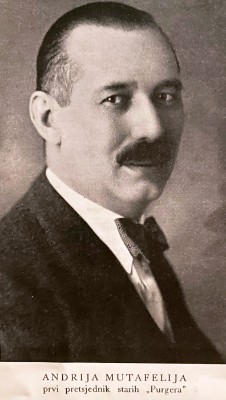
The founding assembly of the Hungarian club in Zagreb was scheduled for 12 April 1911, which, due to massive protests, ultimately failed. However, the idea of founding Građanski came to life, the first club that would bring together all Zagreb citizens. The first public meeting of Zagreb athletes was held on 9 April 1911 in the Nova Pivana on Draškovićeva Street, where it was concluded that preparations for founding the club should begin. Just one day after the failed founding assembly of the Hungarian club, a second public meeting was organized with the theme of preparations for founding Građanski. This was on 13 April at the Matković restaurant at Frankopanska 8, in premises next to today's Gavella Theatre, and more than 300 guests, athletes and citizens participated. At this meeting, a temporary "ad hoc" Committee was unanimously elected, headed by Andrija Mutafelija. The meeting ended in a euphoric atmosphere, with cheers for the new club, Zagreb sport and collective singing of "Lijepa naša".
The Committee met on 19 April and had the task of drafting the club's rules and proposing them to the constituting Assembly, which had to be convened within 14 days.
It was held on 26 April in the Budějovička restaurant in the building of the First Croatian Savings Bank, at the corner of Bogovićeva Street and Cvjetni Square.
The Zagreb club quickly became a bearer of quality in Croatia and beyond, and numerous victories clearly suggest the strength, importance and quality of Zagreb football in that period.
From the very beginning, as well as throughout its entire subsequent activity, the club represented the true Croatian and Zagreb spirit – it was open to everyone, generously welcoming guests from all sides. It was coached by Austrians, Hungarians, an Englishman, an Irishman, and players came to the club from different parts of the world.
With the end of World War II came a political manoeuvre: the name Građanski was banned because it was associated with the society of one class, regardless of the paradox that the club itself was created on exactly opposite principles, on the idea of unity of all social classes.
Within just a few days, first the Minister of Health, Aleksandar Koharović, dissolved the management boards of clubs that had operated during the NDH period and could not continue with names that had traces of national character, and then, on 9 June, an Assembly was organized at which Dinamo was formed.
In accordance with Koharović's decision, "all movable and immovable property of sports forums and clubs of dissolved management boards is entrusted until further notice to the custody and disposal of ZEFIOH, the Regional Physical Culture Committee of Croatia." The removal of national character in practice meant that the names of Građanski's pre-war rivals Građanski and HAŠK were not acceptable.
ZEFIOH was the highest republican sports forum, also authorized to interpret the status and continuity of new and old sports associations. The ZEFIOH representative at Dinamo's assembly on 9 June 1945, Miro Mihovilović, therefore the only one who by his function and legitimacy was competent to judge on this topic, explicitly explained in an interview for Vjesnik: "Dinamo continues the continuity of Građanski in the same way as Croatia later continued the continuity of Dinamo. The club once changed its name to Croatia, therefore to a name that numerous of our clubs in the diaspora already had. Thus, after World War II, they competed to see who would imitate the Russians. Every political power wanted to embrace this club because it is attractive, from Austria-Hungary, through the Kingdom of SCS, the Kingdom of Yugoslavia, NDH, SFRY to today. Just as Croatia continued the continuity of Dinamo, so Dinamo continued the continuity of Građanski."
The Assembly was held on 9 June in the cinema hall of the Zagreb Electric Power Plant, and Građanski had its "base" there, as most of the Zagreb club's players were employed there. Dinamo was presented as a club of city municipal workers, and at that time, therefore, most of Građanski's players were employees of city municipal companies. Soon after, a real club of municipal companies was indeed founded, with the simple name FD Komunalac.
The changes were in name and structure, and Dinamo's continuity with Građanski is visible in the same colours, the stadium in Koturaška, numerous first-team players, but also juniors, coach, even the masseur... Finally, today's Dinamo crest was designed back in 1969 and officially adopted a year later, precisely based on the famous crest from the Građanski era.
In just the first twenty days, 16 players who had previously played for Građanski played for the blues, whether for the first team or junior squad, and we don't even count Milan Antolković who was part of Dinamo but could no longer play due to injury. Along with coach Bukovi, numerous former recruits from Građanski continued to work in professional roles. Furthermore, the Zagreb team played their first match in Split under the new name Dinamo, with local media announcing the arrival in their first reaction with the formulation: "Dinamo is the former Građanski."
There were also public demands from numerous fans for the return of the name Građanski, but such a manoeuvre was not possible precisely because of the aforementioned reason: the name was associated with the bourgeois class, which was not acceptable in the then idea of a classless society.
The continuity of the Zagreb club from the era of Građanski through Dinamo was also emphasized by journalism doyen Žarko Susić, a witness of the times, participant in events and great HAŠK supporter.
State officials responsible for sport in that post-war era insisted on mass participation, so they decided to reorganize sport according to the Soviet model, transforming clubs into – physical culture societies. In practice, this meant that, with the prefix FD, they had to have multiple sports branches, not just a football section.
HAŠK, for example, continued operating under the name Akademičar because the national prefix had to disappear. Since HAŠK was already called "akademičar" in jargon, this became the official name after the war. Akademičar was headed by the same people who had led HAŠK in the same office before the end of the war, led by Ivan Ico Hitrec. Interestingly, Akademičar even legally requested the return of HAŠK's property after the war. Two of them – Hitrec and Medarić – also helped in organizing Dinamo, with Hitrec, parallel to his work at Akademičar as the continuation of HAŠK, helping in the role of technical referee of Dinamo's football section, organizing the first training sessions at the ZET pitch. He also called for help "from his pool" former HAŠK member, coach Branko Kunst, who briefly led the team in the absence of Građanski's coach, Marton Bukovi. After the war, no club had competitive continuity because all previous competitions were interrupted and everyone started from scratch.
The Blues have the opportunity this season to reach their "round" 70th trophy. So far they have stopped at 68. The club has won 35 state championship titles, 24 Cup winners' cups, 8 Super Cups and, of course, the most important trophy in club history – winning the Inter-Cities Fairs Cup in 1967, a competition that eventually grew into the UEFA Cup, today's Europa League.
Because of all the above, Dinamo changed its prefix from NK to GNK on the 100th anniversary of its foundation, thereby symbolically and identity-wise incorporating the dear and glorious name Građanski as an "introduction" to the equally dear and glorious name Dinamo.