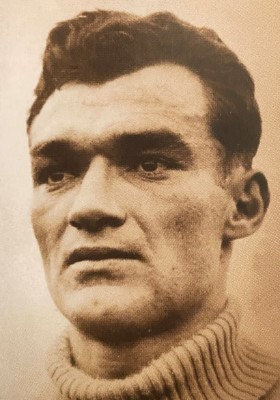
Bernhard Benda Hügl has passed away
He was both a fullback and centre-back, later a meticulous strategist, and had a long and distinguished playing, captaincy, and coaching tenure at the blue club... History remembers him for his solid defensive play, strong character, and distinctive appearance - he was one of the prominent members of the Zagreb team. The turbulent circumstances of life, intertwined with football and political movements, largely determined his fate. Bernhard Hügl, the popular Benda, was one of our club's key players for more than a decade, winning two championship titles in 1937 and 1940, and later as coach in 1951, he won the first Cup trophy in history. He participated in numerous major international victories - he was in the squad when the Zagreb team scored five goals against Liverpool, when they beat Juventus twice and Milan once, when they defeated Austria's national team, the popular "wunderteam", in Vienna, celebrated victories against Vienna's Austria and Rapid, twice against the "Czechs" from München, Viktoria Plzeň, Ferencváros, and when they drew against Brazil's national team in Zagreb... Hügl was instrumental in a series of brilliant results, most often as captain. Indeed, it was he who, wearing the captain's armband, led Građanski to the historic 5-1 victory against Liverpool. He was born on 27 March 1908 in Srpski Miletić in Vojvodina, and his golden Zagreb football episode began when he came to study in Zagreb. He soon became a regular international player, playing 24 matches for pre-war Yugoslavia. After his playing career, he became a coach, leading Zagreb's city selection, and during the NDH period, he took over the national team, which he coached in only one match - its last - in April 1944 against Slovakia. After the war ended, he was sentenced to six years in prison, serving his sentence in Stara Gradiška where he spent five years. He was later rehabilitated and returned to coaching, leading Dinamo for three years from 1949 to 1952. He nurtured the future great star, the famous Tomislav Crnković, and won the first Cup trophy in 1951. It's almost incredible how that same year they let slip an almost certain championship title in the league finale. Three rounds before the end, the blues had a five-point lead, in an era when victory was worth two, not three points. In the last three rounds, they won only one point, so Red Star lifted the trophy. In case of equal points, instead of head-to-head record or goal difference, the final league position was decided by goal quotient. In practice, this meant dividing the number of goals scored by the number of goals conceded. The Zagreb team fell short of the championship title by this criterion, by just 13 thousandths. After Dinamo, he coached Mostar's Velež, which he promoted to the first league, was the coach of Yugoslavia's B national team, but after the "Silver Fox" affair, he permanently moved to Germany. He was coach of Osijek, then called Proleter, when an affair broke out regarding alleged bribery of referees and violation of amateur sporting principles. After two months in investigative detention, he moved to Germany in September 1956. There, however, he continued his football journey by becoming a member of the coaching staff of the West German national team, assistant to the celebrated coach Josef Sepp Herberger. He passed away in Heilbronn. Although he was most often presented in the media as Bernard, the family announced the name Bernhard at his farewell. He died on 10 April, although the date 2 April incorrectly appears in some public sources. His son, of the same name, Bernhard Hügl junior, was also a Dinamo player and later a coaching legend in Jastrebarsko, where he moved in 1967 as a 30-year-old.